
I’ve posted in the past about my World Cup Crew and our travels – starting in 2006 somebody has watched every match played, and a handful of individuals have seen almost all of them – personally I’ve missed a total of maybe a dozen or two over the last quarter century. We’re, you know, into it.
We’ve been eagerly anticipating the domestic tournament pretty since it was announced. As the 2026 version approached, however, all of us began feeling nervous. We were concerned about everything that makes the World Cup special. Like everyone else, we worried that visa issues and global perception of the violent ICE raids would scare away tourists. We worried that our illustrious orange leader would blockade games with ICE agents and arrest tourists or even competitors. And we were completely flabbergasted by the ticket prices; we were certain there would be many empty seats; none of us had tickets when the tournament started because prices were just too damn high. And we were concerned about the most important thing of all, that the expanded field and rule changes would result in worse play in the tournament.
It appears that many of our fears were unfounded. There was no notable ICE presence at games; the visiting fans were plentiful and amazing. There were a plenty of visa issues for the tournament – and boy howdy did Iran get screwed – but it was not immediately apparent during the tournament. And almost all games were well attended; indeed, many of us caved at the end, held our nose, and bought tickets.
And the play – oh, there were so many glorious moments. I really wanted this entire essay (and the one that follows) to just be another in the long line of critics who have been converted; so many have taken the position that this was a great tournament, possibly the greatest ever.
Sadly, they’re wrong. The tournament had some great moments, no doubt about that. They all do! That’s why this competition is so popular! But this iteration of the tournament was deeply, structurally, and irredeemably flawed. FIFA didn’t wreck it, but they sure undermined it. I’ll return to this topic in the next essay; for now, I’m going to ignore all those issues and just talk about some of the good stuff.
One quick note: I retired recently, so I suddenly have a lot of spare time. It’s neat! I like it! And I spent a lot of that spare time during the tournament developing a data visualization app to explore some of the hidden dynamics of the cup. It’s been a lot of fun. I’ve unearthed some interesting things, so I’ll use the data to make my point. However, it’s important to bear in mind that like all statistics, this is merely a useful empirical fiction. I’ve made a ton of assumptions, some of the results may be more about my preconceptions as the underlying truth, but I’ve tried pretty hard to minimize that. The details of my methodology are outlined in this post; I won’t describe them here. With that said, feel free to go play around – it’s pretty data rich. I’m going to add a number of screen captures here (with links to the app), but the app itself has a lot of tooltips and metadata that create a richer experience.
So how good was the tournament?
There were a lot of great, exciting, hotly contested games. There were some great upsets. There were some great teams who stumbled; there were some tiny nations that played like giants. There were amazing storylines. Here I’m going to explore mostly the stuff I found most interesting.
CONCACAF
The USA Overperformed
I live in the USA, and the United States had a great run through the Round of 32 – the lowest rated team in the Group of Death, facing three teams rated higher than they were, and (I’m convinced) would have beaten Turkey if they’d had all their players healthy. Yeah, I’m also a Sounders fan and I think Cristian Roldan had something to say to Turkey. Sigh.
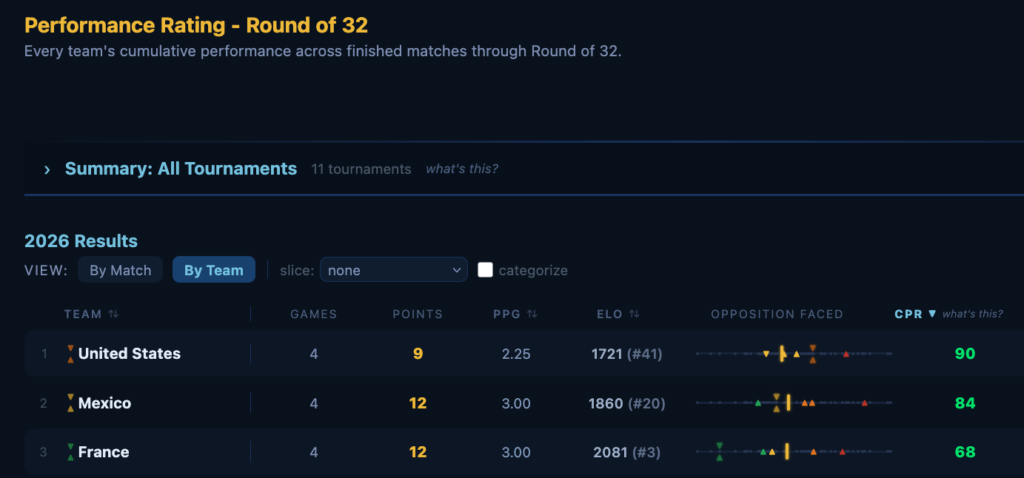
So yeah, for a while, the team had a fantastic tournament.
And then they really, really didn’t. (I sold a car [not literally, but screw you anyway FIFA] so I could watched the USA lose to Belgium live, in the stadium. Genuinely one of the most dispiriting losses I’ve endured. (Only good thing I have to say for it is that it prepared me for the three dispiriting losses the Seattle Sounders have put in since the World Cup. No, really, I’m having a great time as a soccer fan this month.)
Mexico Really Overperformed
Really really!
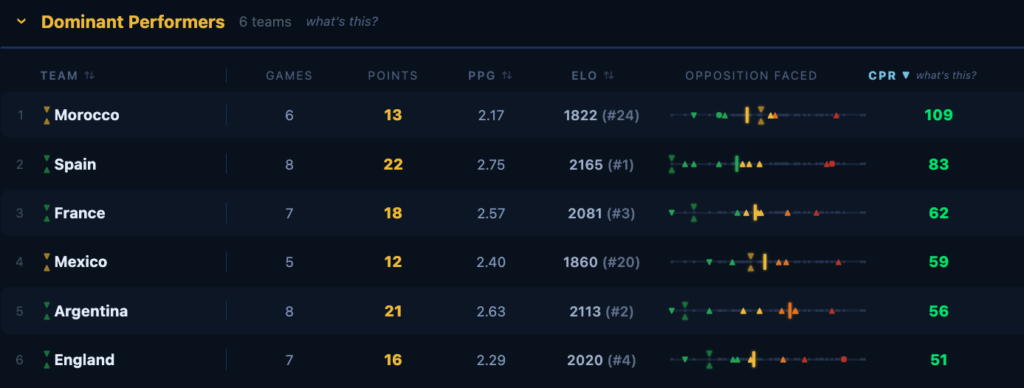
That is some pretty lofty company. And that last game against England was fantastic, until Jude Goddam Bellingham put his country on his back. They only lost one game in the entire tournament, beating #9 ranked Ecuador en route. Well done!
The Rest of CONCACAF were… Bad
If the tournament had ended after the Round of 32, CONCACAF would have looked pretty good; they had put in a 5.0 CPR and performed second only to Africa. Unfortunately, there were more rounds, and when the dust settled, CONCACAF remained pretty securely in the bottom half of the confederations. (But wow, Africa!)
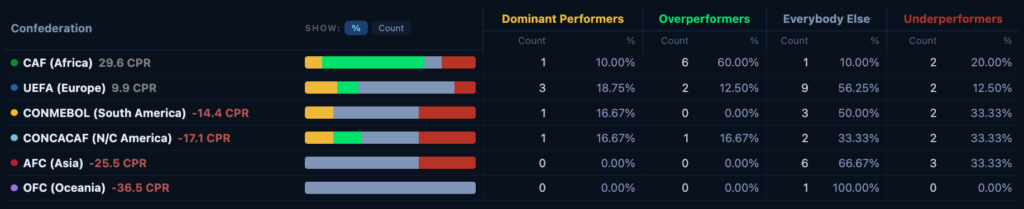
And it turns out that initial perceived overperformance was essentially entirely due to the USA and Mexico. Both Panama and Canada underperformed; Haiti and Curaçao performed about as expected.
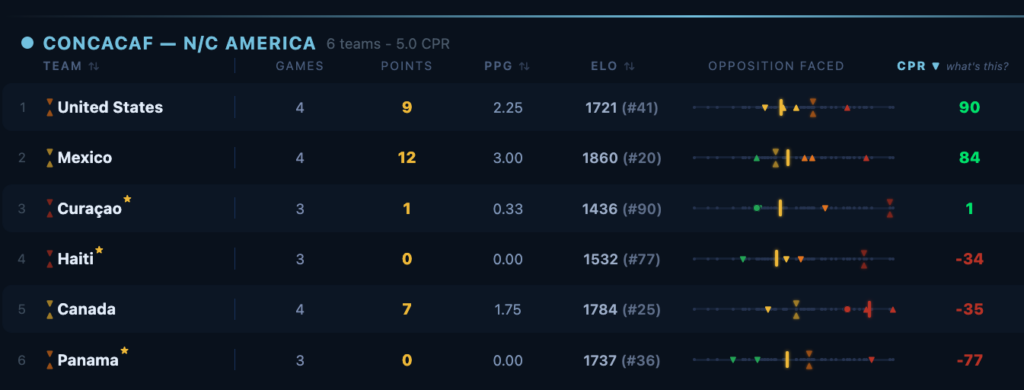
In particular, Canada had an awful performance. They had overall the easiest path of any club in the tournament.
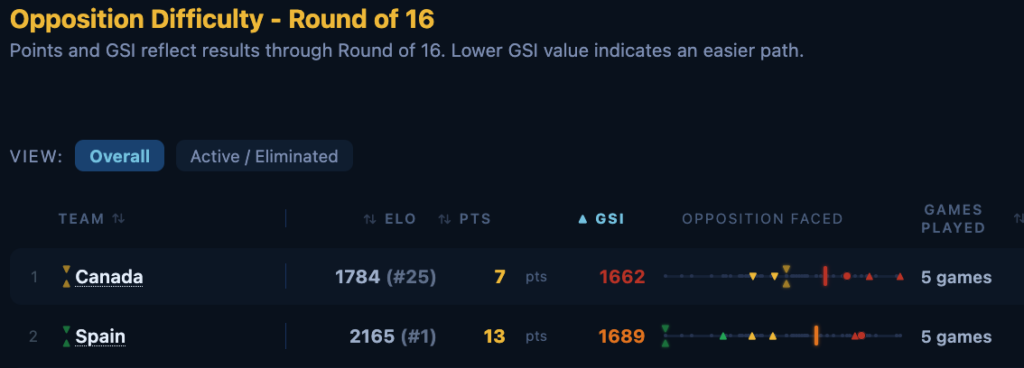
They were hosts, and they won some games… but overall they put in the worst performance in the tournament.
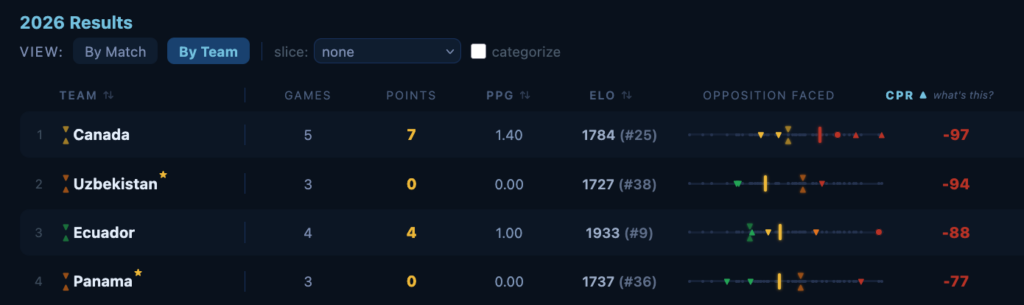
Way to go, Jesse Marsch. Some of my friends had been wishing we had your theatrics and fecklessness (and probably drones, since apparently they weren’t get caught this time) on our sidelines. I’m glad we had none of that.
Cape Verde was AMAZING
We were all impressed by how well Cape Verde played – but not only did they overperform, they did so while navigating the most difficult opposition of anyone in the cup!
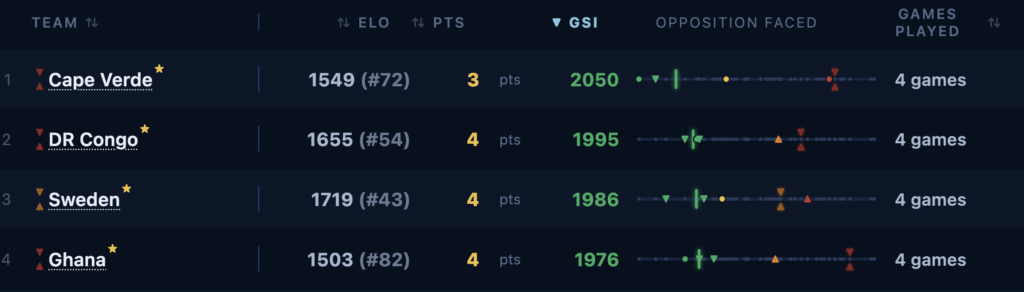
But really, I think Africa may finally be coming to its own. Three of the four African nations faced the stiffest opposition… and of the nine teams that overperformed, six were from CAF (including all three of the African teams facing difficult opposition) – and five of the six most overperforming teams were from the continent.
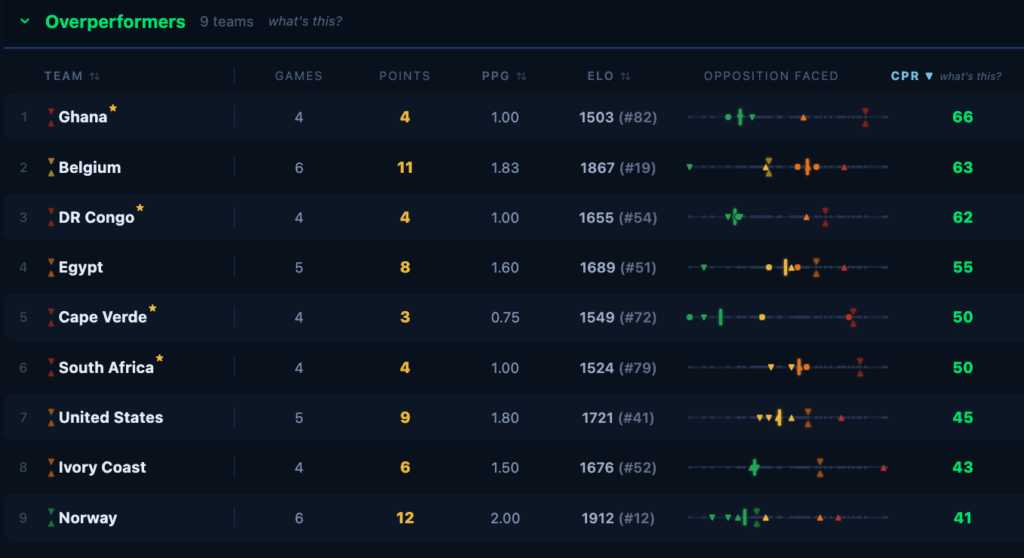
This isn’t really the full picture, either. Both Morocco and Mexico turned in fully dominant performances; that is, they overperformed so much that they graduated into the next category. If we include those teams, there are 11 overperformers; seven were from Africa (and two each from CONCACAF and UEFA).
And even that isn’t the full picture, because Morocco put in the most dominant performance in the tournament.
Conclusion
Ok, I’ll be honest – this is a bit of a fluff piece. There’s not a lot new here, although it’s been fun to put together some statistical analysis that ended up mostly aligned with my intuitions.
So why did I write this? Because the next piece in this series is deeply critical, and I wanted to establish that I’m not a curmudgeon and enjoyed the tournament. I just wanted to enjoy it more, but FIFA is really trying to ruin it for me.
This is Part 2 of a four-part series discussing the 2026 World Cup
| Part 1 Methodology | Part 2 Performance | Part 3 Tournament Structure | Part 4 A Plea to FIFA |
