
In my last post, I discussed the game play in the recent tournament. It was a lot better than I had expected! As I mentioned there, many commentators have taken the position that this was a great tournament, possibly the greatest ever. This post attempts to establish how wrong those commentators are. The tournament had some great moments, no doubt about that. They all do! That’s why this competition is so popular! But this tournament was deeply, structurally, and irredeemably flawed. FIFA didn’t wreck it, but they sure undermined it.
And to repeat the context: I retired recently, so I suddenly have a lot of spare time. It’s neat! I like it! And I spent a lot of that spare time during the tournament developing a data visualization app to explore some of the hidden dynamics of the cup. It’s been a lot of fun. I’ve unearthed some interesting things, so I’ll use the data to make my point. However, it’s important to bear in mind that like all statistics, this is merely a useful empirical fiction. I’ve made a ton of assumptions, some of the results may be more about my preconceptions as the underlying truth, but I’ve tried pretty hard to minimize that. The details of my methodology are outlined in this post; I won’t describe them here.
What are you worried about?
The thing I, and my friends, were most concerned about was that the expanded field and rule changes would result in a less compelling tournament. There were great games, of course; but on balance our concerns were well founded and these changes overall impaired the tournament.
I will explore these concerns from two perspectives:
- Did the expanded field result in overall worse play?
- Did the expanded field result in an overall less dramatic tournament?
Was the overall play worse?
Demonstrably yes.
Blowouts are Boring
I’ve defined a blowout as a victory by four or more goals. We expect blowouts now and again, even from evenly matched teams; everybody has a bad day sometimes. But how many should we expect?
The first world cup was played in 1930 – the next World Cup will be the centennial of the tournament! Since 1930, there have been an average of 0.91 blowouts in each tournament, around once every four years (obviously some years have more, some none).
The “modern era” of soccer is considered to have started in the 1990s, really in 1992. Some structural changes significantly changed the international sport, notably including the creation of the English Premier League and the UEFA Champion’s League, a treaty in the EU allowing free movement of players between countries, and the creation of the “backpass rule” (prohibiting keepers from using their hands when the ball is passed to them by a teammate). On average, since 1992 the World Cup has seen 0.875 blowouts per tournament.
In 2026, there were nine. NINE. Six of them involved the Speical Guest Stars (the 16 teams that would likely not have been involved in a 32-team tournament); Sweden notably participated in two of those, one as the winner and one as the loser.
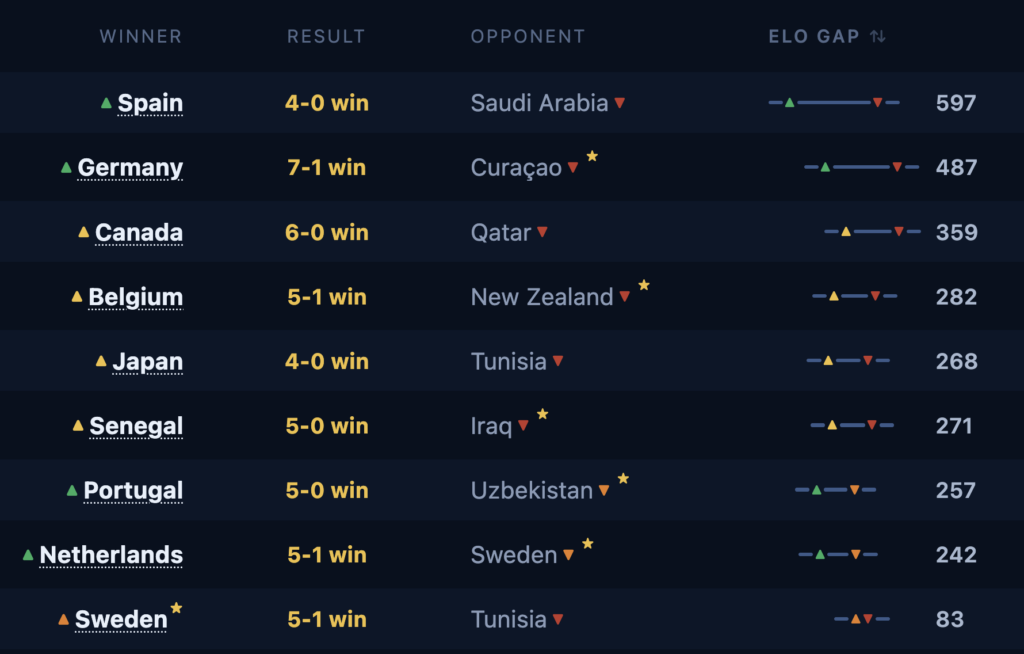
This increase cannot be fully explained by the difference in quality; of the top ten matches with the biggest ELO gap, four were upsets and only two were blowouts.1 (There were 13 upsets in 2026. I haven’t compared that against the historical rates.)
Whatever the cause, this means 7.7% of the games were blowouts – that’s almost 10%. Boy, that was fun.
How Did the “Special Guest Stars” Perform?
I asked several different AIs to tell me which 16 teams would not have participated in a 32-team tournament along with a careful justification, and compiled a list based on all four responses; these are indicated with a gold star – the “special guest star” (SGS) – in the parts of the app for which the distinction is meaningful. In addition I added the ability to slice the analytics by a couple filters, including by the presence of the special guest star. Which means I can quantify how they did.
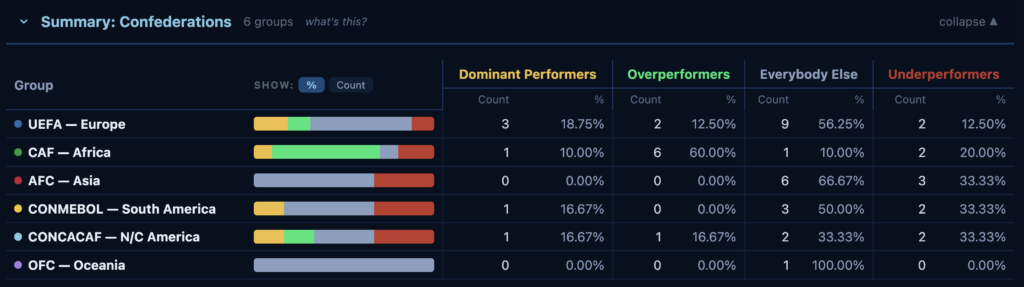
Short story: collectively, better than the rest of the field! The 16 stars got a collective 15.4 CPR (Cumulative Performance Rating), compared to a 7.7 CPR for the other 32 teams. For context, the sixteen teams from UEFA (Europe) had a collective 9.9 CPR; the 9 teams from AFC (Asia) had a collective -25.5 CPR (yes, negative).
Alternate story: about the same as everybody else. One aspect of the collective CPR is that it weights both overperformance and underperformance by how much ELO difference there is between the teams. So that Cape Verde draw against Spain comes across as a huge overperformance, while the Curacao blowout loss to Germany is more or less expected. When we look at pure frequency of overperformance and underperformance without considering the strength of opposition, the SGS performed more in line with the overall trends.

It’s interesting to compare this to how individual confederations performed. AFC and OFC had the weakest performances; UEFA, as always, had the strongest. As discussed in the previous essay, I was struck by how well CAF performed – after UEFA, they had the fewest underperformers, a ton of overperformers, and Morocco turned in another dominating tournament.
How Dramatic was the Tournament?
There was plenty of drama at this tournament. Most fans had something to really cheer for (or at least to suffer greatly!) And as expected, both the quality and stakes of the games rose together, with the final topping the bill with the highest quality and most drama (but not much more than the semifinals). On the face of it, this looks like a great tournament.
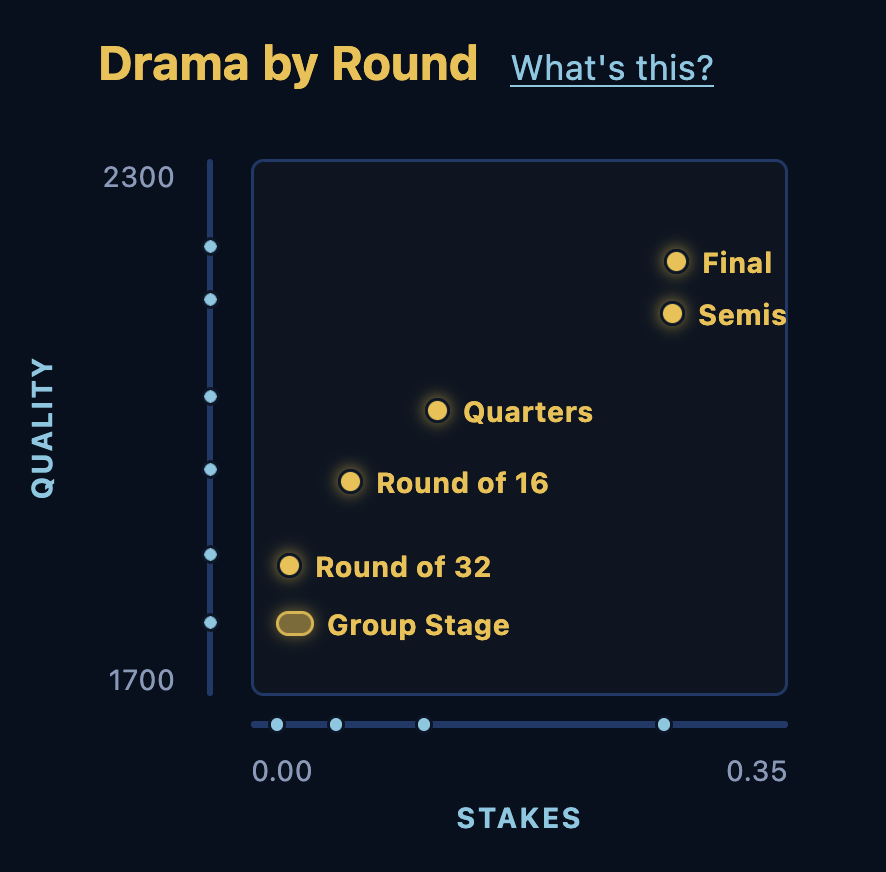
But we can already see some warning signs. Looking at the bottom left corner, the Round of 32 had no more stakes than the group stage – and in fact, lower stakes than some of the group stage rounds. If we look at this carefully, we can see that the stakes for the tournament didn’t start to rise until the Round of 16.
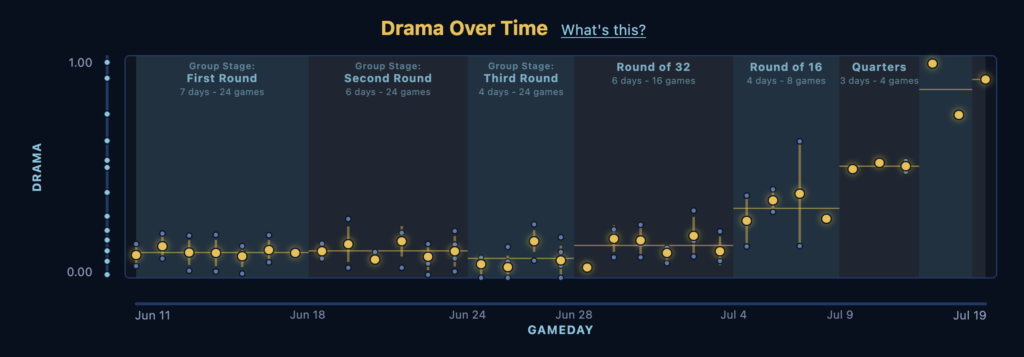
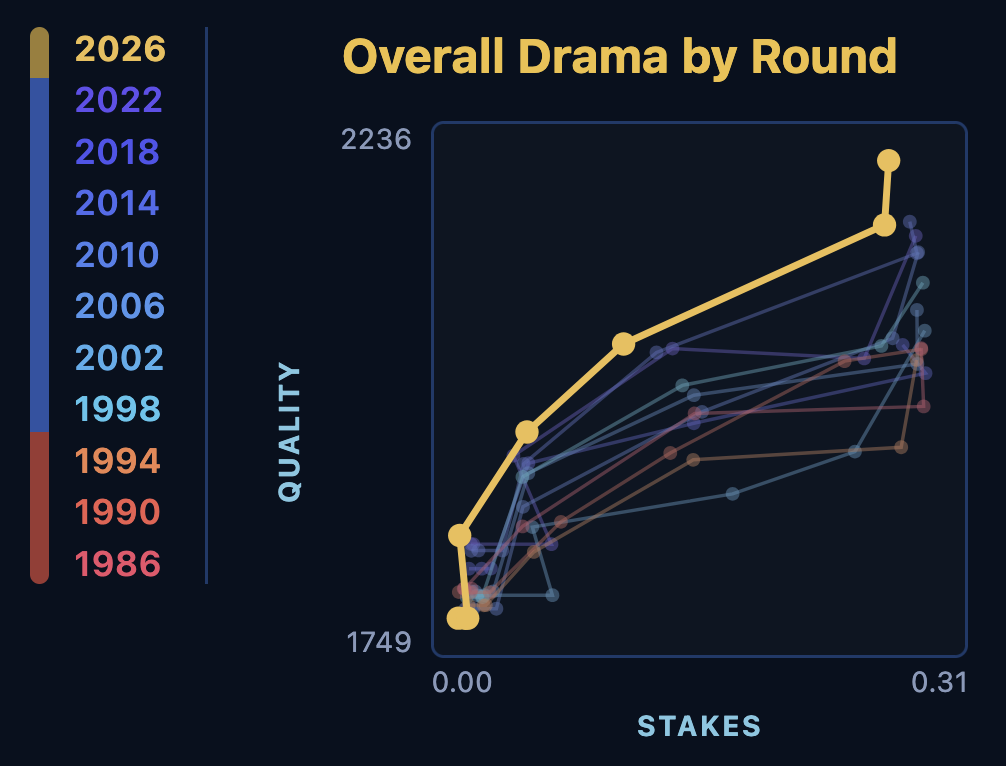
If we compare the drama of this tournament to the historical results from 1986 on, a couple things come into focus. First, the 2026 tournament started with the lowest quality ever. This is inevitable: the 16 extra teams dig deeper into the ELO bucket. Notably, it ended with the highest quality! These may be correlated, but there are a lot of confounding variables; personally I suspect the “head-to-head” tie-breaker was responsible, but I haven’t bothered chasing it down. I’m running out of motivation, but I confess I’m curious what the tournament might have looked like with a sane first tie-breaker. Nice going, FIFA.
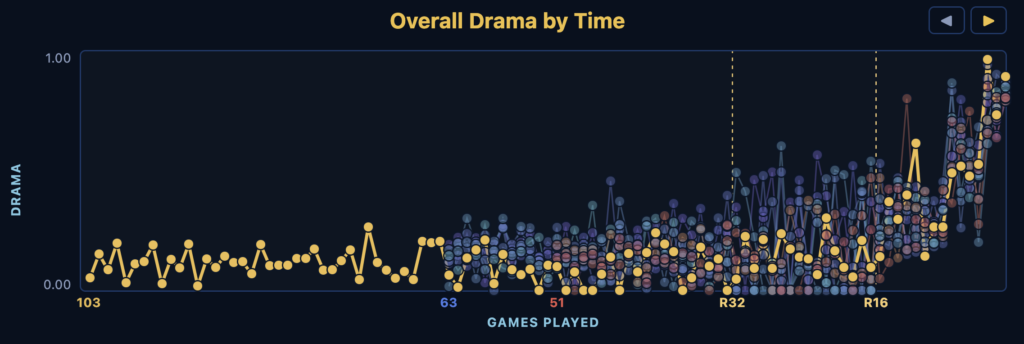
Now, let me talk for a moment about the Round of 32, introduced in 2026 due to the expanded field. This was billed as an “elimination round” – which of course it putatively was. However, the Drama over Time graph above makes it clear that the stakes of this round were completely indistinguishable from the stakes of the seventy-two games that preceded it. The Round of 32 was not an elimination round, any more than the last round of the group stage was. For clarity and conformity I will only refer to games from the round of 16 on as elimination rounds – conformity because of course these were the only elimination rounds in earlier tournaments; clarity because it correctly classifies the round of 32 as what it actually was: the final round of a very, very long group stage. As we can see above, for the first twenty three days of the tournament – almost a month – there was essentially no change in drama.
Where this really comes into focus is in comparison with prior years, and I think the following graph makes the point emphatically. Here I’ve graphed the drama of every game played since 1986, with the “origin” of the graph line on the right so the finals are all lined up on the right margin and the Round of 16 starts at the same point for each. The highlighted, bright gold line is the same data presented above, representing the drama of the 2026 version; for 2026 only there’s another line indicating the beginning of the Round of 32.
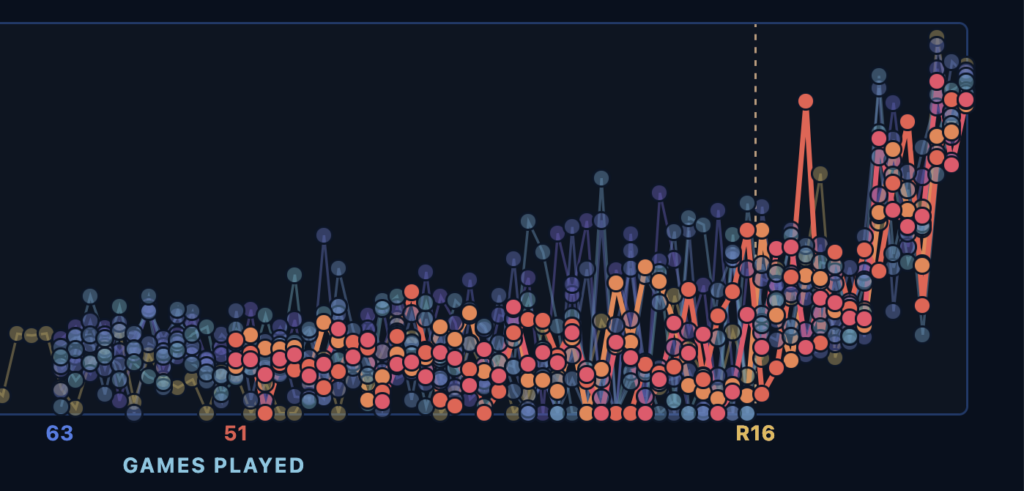
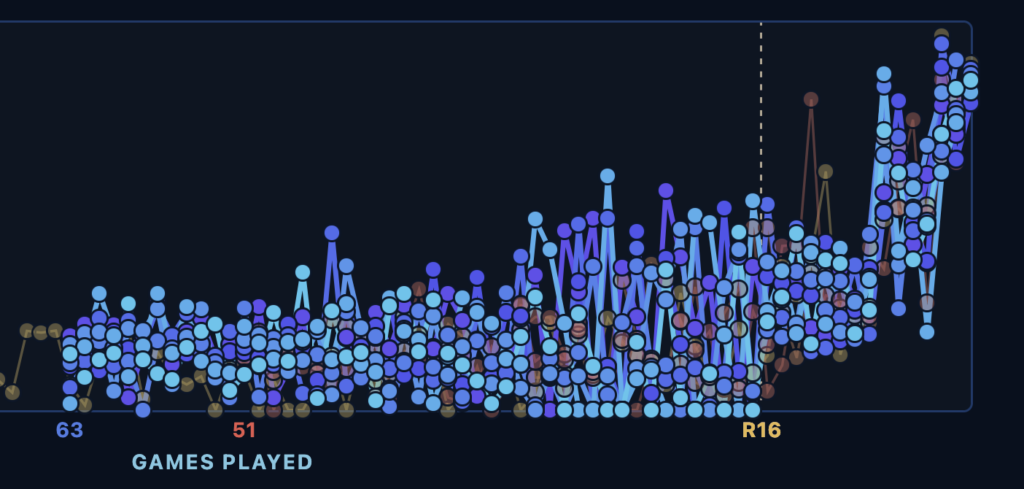
Historical Drama, 1998-2022 (years with 32 teams) highlighted.
There are a couple things this graph tells me. First, it really emphasizes how little difference there is between the Round of 32 and the group stage – it is in fact indistinguishable from the final round of the group stage in each prior year. It simply adds little to the tournament.
But more importantly, it reveals the clear and obvious error in how this tournament was designed. That long, undifferentiated preamble of forty games serves only to make the tournament longer. It adds little drama; it adds negligible story (compared to previous years, there are always tiny yet mighty participants); it just adds games. Many, many games.
Yes, yes, I know. Those teams got to participate in the World Cup! How cool is it for Curaçao to be there?! How dare I suggest they weren’t important? I get it; really, I do. But the question is whether that is worth it. For me, absolutely not. I love this tournament. I have watched almost every game since 2006. And this year, by the time the Round of 32 rolled around, I was exhausted and even somewhat bored. An hour between games isn’t enough. Four games a day is too much. A solid month of low-stakes games isn’t compelling. And the games just weren’t different enough, for the most part, to actually care.
Conclusion
For me and my friends, in 2026 the group stage was endless and frankly became quite tedious. Again I include the Round of 32 as the new final round of the group stage – the drama and quality are completely in line with the rest of the group stage. Calling it an elimination round on par with the Round of 16 is a real disservice to prior tournaments.
Really, without Cape Verde and maybe the Boston Scots, it hasn’t been a particularly memorable tournament. Hell, even the final was a bit of a disappointment, though the semifinals were great. So I invite you to ask yourself: does one glorious overperformer justify the expanded tournament? Bear in mind that the expanded tournament included lower overall quality, and consequently a lot (a lot a lot) more low stakes games.
For me, I think it depends on what you want out of the tournament. It is billed as the pre-eminent collection of soccer on the planet, an endless parade of compelling games and stories. There have been tournaments that come close to that; the 2022 cup came pretty close. Upsets, the dramatic arrival of Morocco as a soccer power, and a final for the ages.
This was not that.
It feels to me that FIFA is transitioning the world cup away from being a singe, long, glorious event to be consumed like a bountiful feast. Instead, it is being driven towards becoming the sports equivalent of a film festival: a collection of events from which we should select the events that sound interesting, and skip the boring parts. They are making it something to be sampled, not something to be lived.
Personally, I think it’s a real loss.
Epilogue: Expanding the Cup
Before I continue, I think it’s important to revisit some language for a moment. In one of the first essays of this series, I noted the distinction between the “World Cup” and the “World Cup Finals” – when we think of the “World Cup,” we generally mean the finals: the last step in a multi-year process, global in scope but continental in practice. The cup actually starts next year when the various confederations begin the qualifying rounds for the 2030 World Cup Finals which will be held in Morocco, Spain, and Portugal. This distinction usually more or less semantic, but here it matters. It matters when FIFA talks about “expanding the cup.” They are not expanding the cup – they can’t! FIFA recognizes more countries than the UN does, and the World Cup includes every one of them.
What “Expanding the Cup” actually means is that FIFA is redefining the last round of qualification, nothing more. And what the teams are qualifying for is the finals! All of those 16 extra teams had already participated in qualification for years within their continent. All that FIFA is proposing is to remove a layer from continental qualification and redefine it as part of the finals. And the way they chose to do so was to mix them directly into the existing format. This was the direct cause for all the problems described above. The big tournament simply should not have more than 32 teams. And yeah, that’s a hill I’ll die on.
Well, ok. But should we be paying attention to more teams during qualification? I think the attention those extra games got this year suggests we should! The quality of some of those guest stars warranted it. I’d have watched a bunch more games with Cape Verde in them. But I got more than my fill of Haiti, Iraq, Jordan, Panama, and Uzbekistan – all “Special Guest Stars,” with zero points between them. Did they really improve the cup?
Or, more directly, if we must redefine how the qualification rounds work, is the best way really to have a much larger field in the Finals?
In case it’s not obvious by now, I’m pretty passionate about this competition, and found this to be a very disappointing iteration. And yes, I do think there are better ways.
So let me propose one, and it’s a blindingly obvious suggestion – but it would eliminate all the problems I’ve discussed here. I think it would be more exciting than what preceded it in 2022 and earlier. And it would of course satisfy FIFA’s bottomless greed – perhaps not Infantino’s greed, and certainly not FIFA’s pervasive corruption, but it would at least result in a more satisfying tournament. It’s simple and obvious; but it does present a serious logistics problem.
If we must expand the field, let’s introduce the World Cup Prequel Gauntlet of Fringe Soccer Nations (ok, maybe the name needs work). Qualify 28 teams for the finals directly, like the 32 that qualified in 2022. Then invite the extra 16 to a prequel tournament. Collect those 16 fringe teams from across the globe; divide them into groups of four as usual. Each team participates in a full group stage, but only the winner of each group advances – so a total of four teams qualify by running this gauntlet. (Of course, if FIFA insists on expanding to a full 32 team prequel, then have a round of 16 and an elimination round of eight to winnow down to the top four. Or, hell, send only 16 directly to the finals, and have16 qualify by way of the WCPGFSN prequel tournament – but of course that wouldn’t satisfy FIFA’s desire to overcharge for tickets for an interminable and increasingly monotonous tournament. Which is why I like the smaller prequel.)
This seems reasonable and structurally sound from a tournament construction perspective. However, there are real and serious logistical problems with this approach.
First, it requires organizing an entire tournament in addition to the existing one. That’s not trivial, but it’s certainly surmountable. In fact, I’d argue it’s less work than mixing those additional games into the finals. If we go with my proposal and have only a group stage, that’s only six games per group. Each group could be assigned to a pair of cities, anywhere in the world (independent of the finals – hey, this is small enough you could do it in Asia!); each city would host one game every three to four days, and only two teams would have to travel between rounds. Given FIFA’s appetite for American money, FIFA could just run it in the US every four years.
More challenging is the logistics for the countries involved. For those four teams that qualify, they have to arrange travel and staff and so on; but again, this is no worse than the current approach. Similarly, an argument can be made that the teams in the prequel are playing three extra games compared to the rest of the field. But this is not a new challenge.
Here’s the thing: this tournament kinda sorta happened already. There was what is effectively a mini-tournament in the spring of 2026. Sixteen UEFA teams played two single-elimination rounds, one on March 26 and one on March 31; four of the special guest stars (Bosnia and Herzogovina, Sweden, Turkey, and the Czech Republic) qualified for the finals. I ignored that – it was just qualification, right? But expand that, invite teams from across the globe, make it an event with a real group stage, and we’re off to the races.
For the record, I would absolutely watch that tournament with great relish.
Footnotes
- If I were forced to speculate, I’d investigate the impact of the hydration break. But I don’t have the data to do so. ↩︎
This is Part 3 of a four-part series discussing the 2026 World Cup
| Part 1 Methodology | Part 2 Performance | Part 3 Tournament Structure | Part 4 A Plea to FIFA |
